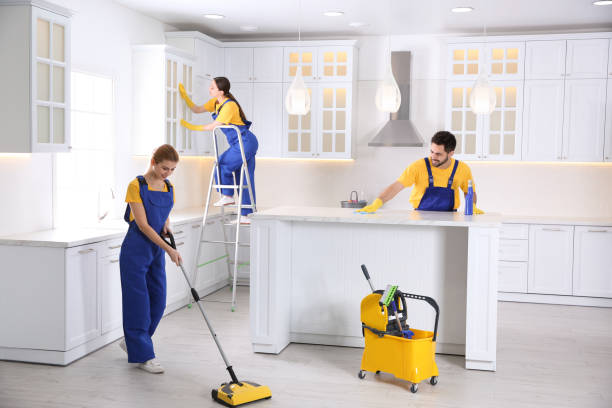

Food safety inspections in commercial kitchens are not announced in advance — and that is the point. Inspectors arrive when the kitchen is operating or has just finished service, under the conditions that actually represent the kitchen’s day-to-day cleanliness standard rather than the standard achieved during a pre-inspection deep clean. Kitchens that only clean well before known inspections are the ones that accumulate violations. Kitchens that clean well all the time pass inspections as a matter of course.
Deep Commercial Kitchen Cleaning Services on a regular schedule — not just in response to an upcoming inspection — are what build the consistently clean kitchen that passes when the inspector walks in without warning. They address the grease accumulation, the equipment interiors, the drain systems, and the floor surface conditions that daily kitchen cleaning cannot reach.
Grease Accumulation: The Hidden Hazard That Builds Slowly
Grease is the defining challenge of commercial kitchen cleaning. Cooking produces aerosolized grease particles that deposit on every surface in proximity to cooking equipment — the hood, the walls behind the range, the equipment tops, the floor in front of the fryers. Daily cleaning manages the surfaces that kitchen staff can reach during end-of-service cleaning. But grease migrates into spaces that daily cleaning does not address: behind and beneath equipment, into the exhaust system beyond the filters, onto the structural elements of the kitchen that are not part of the visible cleaning routine.
Professional deep cleaning reaches into these areas with the chemical formulations, the application methods, and the physical access that commercial kitchen grease requires. Heavy-duty alkaline degreasers applied with hot water pressure, allowed appropriate dwell time, and rinsed thoroughly remove grease that has hardened and accumulated over weeks or months. The result is surfaces that are not just clean in appearance but genuinely free of the grease residue that creates fire risk and harbors bacteria.
Floor Drain Cleaning and Odor Management
Commercial kitchen floor drains are among the most bacteria-laden surfaces in any food service facility — and among the most neglected in cleaning programs. Drains accumulate organic material from food preparation and cooking that provides a rich nutrient source for bacterial growth. The biofilm that develops in drains and trap components is both a hygiene issue and an odor source that affects the kitchen environment and can carry into customer-facing areas of a restaurant.
Deep kitchen cleaning includes enzymatic drain treatment that digests organic accumulation in drain traps and pipe interiors, physical cleaning of drain covers and accessible drain components, and in some programs pressure flushing of drain lines to remove accumulation that has built up beyond the trap. Regular drain cleaning as part of a deep cleaning program prevents the drain odor problems that are a common cause of health code citations.
Documentation for Health Department Compliance
Colorado food service facilities are subject to health department inspection programs that evaluate both operational food handling practices and the cleanliness and condition of the kitchen facility. Deep cleaning documentation — records showing what was cleaned, when, by whom, and with what products — supports compliance conversations with health inspectors and demonstrates the facility’s commitment to food safety that goes beyond the minimum required. Professional Commercial Kitchen Cleaning Services from PBC Cleaning include that documentation as a standard deliverable, giving kitchen operators the records they need for compliance assurance and the confidence that comes from working with a cleaning partner who understands food safety requirements.